The Stories Of Vietnam’s First Currency
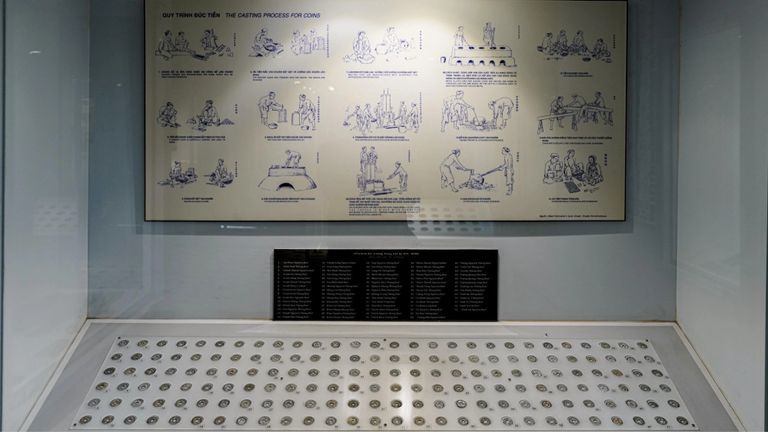
Ancient coins displayed in the Ho Chi Minh City Museum’s exhibition area offer a glimpse into Vietnam’s history of trading and economic life for centuries. | Source: Travellive
For over a millennium, from 111 BCE until the 10th century CE, Vietnam existed under successive periods of Chinese domination. During this era, Chinese political systems, Confucian governance, writing systems, and monetary practices deeply influenced Vietnamese society. Chinese bronze cash coins circulated widely throughout the Red River Delta, serving both commercial and administrative functions.
But by the 10th century, the political landscape of Vietnam began to shift dramatically. Following the victory of Ngo Quyen at the Battle of Bach Dang River in 938, Vietnam gradually reclaimed autonomy from Chinese dynasties. Yet the country remained politically fragmented, eventually descending into the chaos known as the “Anarchy of the Twelve Warlords.”
That instability ended when Dinh Bo Linh unified the territories in 968, proclaimed himself Emperor Dinh Tien Hoang, established the capital at Hoa Lu Ancient Capital, and renamed the nation Đại Cồ Việt. His reign marked the birth of an independent Vietnamese feudal state, and with it came the need for symbols of sovereignty that could distinguish the country from its northern neighbor.
One of those symbols was currency.
The Vietnam’s first currency marks the end of a millennium Chinese rule
In premodern East Asia, minting coins was an economic decision and also acted as a declaration of political legitimacy of a country.
For centuries, Chinese coins had dominated circulation in the region, including in Vietnam. Continuing to rely solely on foreign currency would have reinforced the perception that the newly independent state still remained within China’s political orbit. By issuing its own coinage, the Dinh dynasty signaled that the Great Viet State (Đại Cồ Việt) possessed its own emperor, its own reign era, and its own authority over commerce and governance.
In 970, Emperor Dinh Tien Hoang adopted the reign title “Thái Bình,” meaning “Great Peace,” and ordered the casting of Vietnam’s first official coins: the Thái Bình Hưng Bảo (970-980).
The “Prosperous currency of the Thái Bình era”
The name “Thái Bình Hưng Bảo” (太平興寶) can roughly translated as the development and prosperous of a currency in the Thai Binh era - the reign name of a dynasty which means peace, tranquility, and national stability.
Pride of the Dinh dynasty, the Thai Binh Hung Bao coin was the first coin of the independent feudal state of Vietnam. The oldest is dated to the reign of King Dinh Bo Linh, in 968. It was cast in bronze, the coins followed the familiar East Asian cash coin design: circular in shape with a square hole at the center. The round exterior symbolized the heavens or universe, while the square center represented the earth - a cosmological concept inherited from Chinese philosophy.
Historians have long debated whether coins bearing similar reign titles existed in China during the same period. However, many historians argued that this coin possessed distinct stylistic differences, especially the character “Dinh” engraved on the reverse side - a feature absent from contemporary Chinese coins.
According to former National Museum of Vietnamese History director Pham Quoc Quan, the character “Hưng” in Thái Bình Hưng Bảo was particularly significant. Prior Chinese coins typically used the terms Thông Bảo, Nguyên Bảo, or Trọng Bảo. “The word Hưng was a creative choice by the Dinh dynasty,” he explained to Thanh Nien news: “It carried a blessing for the enduring prosperity of the Great Viet State and the hope that the nation would enjoy lasting peace.”
Coins as symbols of state sovereignty
The traditional Vietnamese monetary system rests on the joint use of three monetary metals, zinc, brass and silver as money.
Throughout Vietnamese history, each dynasty would continue the tradition of minting coins bearing its own reign title. The Ly, Tran, Le, and Nguyen dynasties all issued their own cash coins as a way of reinforcing imperial legitimacy and economic authority.
Because a money-based market was still in its infancy in the 10th century, these coins mostly circulated alongside barter goods (like rice and textiles) rather than acting as the sole driver of the economy. Exact historical records do not define a rigid fixed exchange of the Thai Binh Hung Bao coins to everyday goods, but they served to pay taxes, establish economic sovereignty, and facilitate trade.
More than a thousand years after it was first minted, Vietnam’s earliest coin continues to appear in museums, historical exhibitions, and even contemporary popular culture. Recently, enlarged replicas of the coin were displayed in promotional exhibitions for the film “Hộ Linh Tráng Sĩ - Bí Ẩn Mộ Vua Đinh” (The Guardian Heroes: Mystery of King Dinh’s Tomb), a historical fantasy film inspired by the folk legends surrounding the tomb of Emperor Dinh Tien Hoang.