Vietnam Survival Guide: Lunar New Year Celebration 101
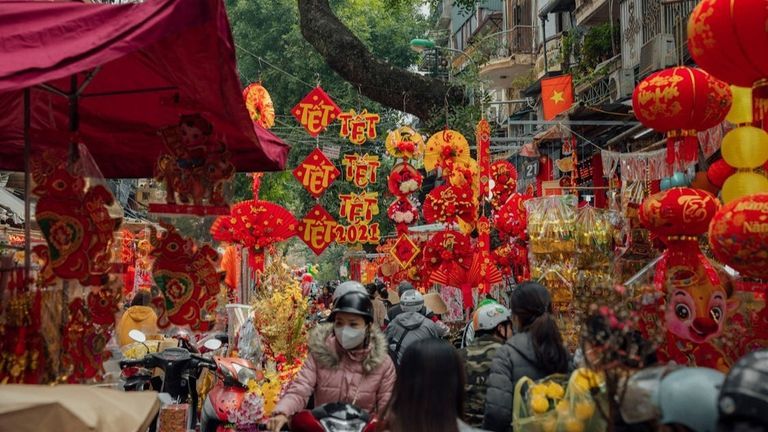
When vibrant red and yellow paint the crowded streets, you'd better prepare as Tet is coming. | Source: Hong Son for Pexels
Tet, short for Tết Nguyên Đán, is the Vietnamese Lunar New Year and the most important celebration of the country, marked by family rituals and spiritual beliefs.
Roaming through Vietnam during Tet, especially for the first time, can be a mix of curiosity, excitement, bewilderment, and even mild panic. One week, floral displays illuminate the streets, and people in colorful ao dai crowd the sidewalks. Suddenly, one morning, the city empties without any warning. Traffic thins. Shops close. And you are told not to sweep floors and put out the trash. It might get even trickier if you are invited to a Vietnamese home. You might wonder: How should I behave? Why is everything gone? How do people live these days? Or just simply: How do I survive Tet?
Below is our guide on how to move through the Tet with preparation, respect, and joy.
Understand the Tet timeline
Tet follows the lunar calendar, so its dates change every year. It’s not just a one-night celebration; it stretches over weeks, with different days holding different meanings. Thus, knowing the Tet timeline will facilitate your plan.
Tet is underway when Vietnamese people start counting days using the Lunar calendar with phrases like “26 Tet” - being the 26th day of the final lunar month. In 2026, that date falls on February 13.
Tet starts even a week before Eve, with rituals and preparations that gradually transform the country into a celebratory vibe.
On 23 Tet, people release carp into rivers or lakes as a ritual of sending back to heaven to report the household’s affairs over the past year and wish for peace in the coming one. Though the mythology may sound foreign, the symbolism is clear: a chapter is closing.
From 24 to 28 Tet, Vietnam enters full preparation mode. Decorative lights stretch across roads, highlighted by creative miniatures of the year’s zodiac sign. Supermarkets are crowded with people buying gifts and Tet ornaments. Flower markets bloom with the fragrance of peach blossoms, kumquat trees, and chrysanthemums, while local cultural events constantly appear. Zooming in on local homes, residents are seen displaying the national flag, preparing offerings, visiting their ancestors’ graves, and thoroughly cleaning their homes.
Then comes 29 Tet, New Year’s Eve. Businesses wind down, and people rush back to their hometowns for family reunions. While the streets are getting silent, laughter and blessings echo through every window and alleyway. People dress up and gather in intimate dinners, counting down to the new year. And when fireworks light up the sky, a new chapter is set.
The first three days of the new year are primarily dedicated to family. Indoors, customs of Tet greetings and giving out lì xì (red envelopes or lucky money) continue as people visit their relatives or close friends.
The most practical advice here is to track the lunar calendar and check the opening times of tourist attractions in advance.
Stock up before the eve
In the days leading up to Lunar New Year's Eve, most restaurants, cafés, and convenience stores begin closing, leaving cities unusually quiet and options limited. Three days leading up to New Year’s Eve, it is recommended to make a list of essentials and shop in advance. Ready meals, instant food, fruits, snacks, or drinks - grab anything that can carry you through a few silent days. At the same time, Tet invites you to taste the holiday itself. Traditional Tet dishes are made to last for days. So get yourself bánh chưng or bánh tét (steamed sticky rice cakes filled with mung beans and pork) along with chả lụa (Vietnamese pork sausage) at any nearby supermarket, and you will be surprisingly well-fed.
Furthermore, pay attention to the opening times of your favorite shop, usually displayed outside the doors, or ask the owners directly to map out where and when to purchase. Nowadays, some local food stalls and shopping malls in the centers often serve through Tet or reopen early on the second or third day of the new year, so if you stay in big cities, worry not. District 1 in HCM City, Hoan Kiem District in Ha Noi, and Tran Phu Street in Da Nang are go-to places after the Eve.
Time your visit to Vietnamese homes
Knowing when to visit a Vietnamese home is delicate, regardless of your intention or invitation. According to the custom of xông đất (first-footing), the first person to enter a house after midnight on New Year's Eve determines the household’s fortune for the upcoming year. Due to this belief, families are cautious of who that person will be, typically someone with a compatible zodiac sign and a reputation for good character. Thus, don’t drop by unannounced on the first day of the new year. Instead, the second and third days, which are more socially open, are recommended for visits. If, however, you are invited to be the first visitor, take it as a genuine honor. Come with a smile, knowing that you are trusted to bring luck to the family.
Act appropriately when you arrive
Unlike usual days, visits now adhere to strict social rules, as all gestures are tied to beliefs of fortune. First and foremost, dress modestly and opt for bright colors. Traditionally, black and white are associated with mourning, making them colors best avoided during the Tet. It is also advised against arriving empty-handed. Fruit baskets, tea, coffee, sweets, or wine are all safe and appreciated gifts.
You can make a great impression by learning a few Tet greetings in Vietnamese. Even a simple “Chúc mừng năm mới” (Happy New Year) can instantly warm the room as it shows your care for local culture. Additionally, given that singing is a popular activity in Tet gatherings, preparing a few karaoke songs will help you blend in. And if there are children or younger family members present, offering small red envelopes is customary. 20,000, 50,000, or 100,000 dong - the amount does not matter much; crisp, new bills are more than enough, since what you’re giving is your blessing, not just money.
Finally, be mindful of the ancestor altar. Vietnamese people have offerings to their ancestors during Tet, inviting them to celebrate together and bidding farewell to them when Tet is over. Thus, touching items on the altar is discouraged, and also avoid sitting with your feet pointing directly toward it. Showing respect is less about fear and more about recognizing the connection between generations.
Lean into the confusion
The sudden silence and what not to do may be the hardest part. Yet instead of resisting, try leaning into them. Despite the rigidity of customs, routines begin to loosen, and time begins to stretch. Cities reveal a rare quiet identity, and sidewalks become walkable. Given that Tet is designed for reconnection with family, with memory, and even with oneself, this is a perfect moment to create personal rituals. Morning walks. Journaling. Or simply allowing yourself to do nothing. Who knows, the stillness and confusion of Tet can eventually be restorative.
In the end, surviving Tet isn’t about knowing all the rules but adjusting your pace to match a country. So don’t try hard to get through it; let it get through you.