The $1.3B Paradox: Why Global Beverage Chains Keep Struggling In Vietnam
Source: Collected
Vietnam is a nation fueled by drinks.
Coffee is a fundamental socio-economic institution. Cafés across the country double as remote offices, informal boardrooms, and neighborhood social hubs. Tea culture is equally pervasive, and milk tea has firmly anchored itself as a staple among younger demographics. Crucially, Vietnamese consumers are increasingly trading up, demonstrating a strong willingness to pay premium prices for specialty beans, artisanal brews, and elevated atmosphere.
On paper, this environment represents an investor’s dream. In 2025, Vietnam’s modern coffee and tea chain market reached an estimated valuation of $1.34 billion, solidifying its position as the third-largest market in Southeast Asia. Sector expansion continues to outpace regional averages, with coffee chains accounting for $725 million (up 27% year-on-year) and tea chains reaching $617 million (up 28%).
Yet this booming demand is precisely what makes Vietnam one of the most hostile operating environments for international beverage franchises.
The core challenge for foreign entrants is market displacement. The issue is neither a lack of consumer spending power nor an aversion to global brands. Rather, foreign chains are entering a mature, hyper-localized ecosystem where consumer preferences are deeply entrenched, domestic competitors are remarkably agile, and an exceptional cup of coffee can be purchased on almost any city block.
For global beverage franchises, there are many ways to fail in Vietnam.
Starbucks: When Global Prestige Surrenders to Local Craft
When Starbucks launched in Ho Chi Minh City in 2013, its primary asset was not its roast profile, but its brand halo. The iconic siren cup offered Vietnamese consumers a tangible slice of Western cosmopolitan status: a clear, aspirational step up from traditional neighborhood cà phê stalls.
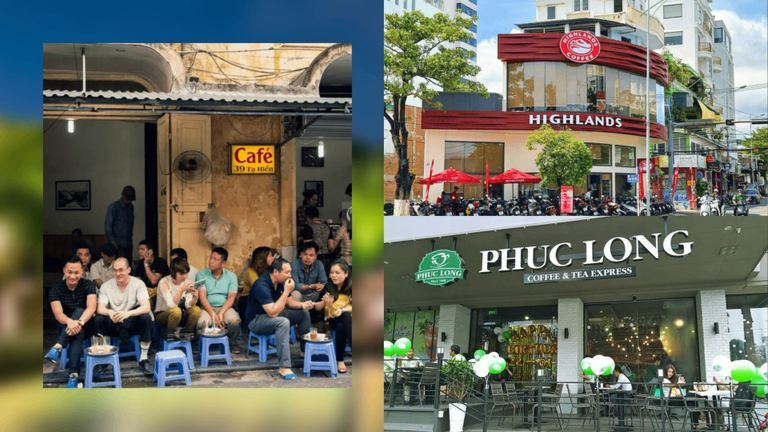
A decade later, that status moat has effectively evaporated. The strategic limits of relying on global brand equity in Vietnam are starkly visible in market footprint numbers. By the end of 2024, Starbucks had managed to expand to just 125 stores nationwide. By contrast, domestic market leader Highlands Coffee reached 985 locations by year-end 2025, while mass-market player Milano Coffee claimed a footprint of roughly 2,500 units.
The fundamental challenge facing Starbucks is not simply that its light, Arabica-heavy menu contrasts with Vietnam’s strong Robusta tradition. The broader structural shift is that Vietnam’s domestic coffee ecosystem has premiumized from within.
As a global coffee-producing powerhouse, Vietnam has built a sophisticated indigenous café culture around signature serves like cà phê sữa đá, bạc xỉu, coconut coffee, and egg coffee. Today, a wave of domestic specialty roasters and third-wave operators is elevating those foundations. Hanoi’s recent recognition as the No. 2 coffee city globally in Food & Wine’s 2026 Global Tastemakers Awards underscores how aggressively local operators are winning on craft, experimenting with high-grade local Robusta, artisanal roasting, and modern conceptual design.
This domestic elevation fundamentally alters the consumer value equation. Where customers once faced a simple trade-off between a cheap, informal local coffee stall and an expensive, polished international brand, today’s market presents a much more competitive matrix. A consumer allocating 80,000 to 100,000 VND (approx. $3.20–$4.00) for a drink is no longer paying purely for status at a global chain. They can spend that exact same discretionary budget at a homegrown specialty café offering superior bean provenance, distinct localized flavor profiles, and a far more tailored hospitality experience.
Under this new dynamic, Starbucks is no longer the default standard for premium coffee; it must actively explain why its standardized global offering commands a price premium over superior local craft.
Compounding these core product-market challenges are geopolitical headwinds. As a high-visibility American multinational, Starbucks has absorbed consumer boycotts linked to geopolitical conflicts, introducing macro reputational risks that domestic competitors never have to manage.
Starbucks remains viable, however, crossing its 150th store milestone in January 2026 while pivoting toward second-tier cities and incremental menu localization.
Chagee: Flawless Product Alignment, Severe Geopolitical Friction
If Starbucks illustrates the challenge of product-market mismatch, Chinese tea titan Chagee represents a far more complex strategic failure: achieving near-perfect product alignment while incurring catastrophic brand liability.
On paper, Chagee’s market entry playbook was built for success in Vietnam. Founded in Yunnan in 2017, the chain built its enterprise model around modernizing traditional Eastern tea culture, scaling to 7,453 global stores by the end of 2025. Unlike Western coffee chains attempting to shift local habits toward Arabica, Chagee’s core portfolio of premium, fresh-milk teas naturally aligned with regional palate preferences and existing tea-drinking routines.
Yet Chagee ran into a structural wall completely unlinked to product quality or supply chain execution.
In March 2025, during a pivotal expansion phase, Vietnamese consumers discovered that Chagee’s official digital channels displayed imagery containing China’s controversial "nine-dash line", a direct violation of national sovereignty sentiment in Vietnam. The backlash was instantaneous: an intense viral boycott erupted, and the company's proprietary app was swiftly removed from domestic app stores.
This crisis exposed a fundamental vulnerability in consumer lifestyle branding, shifting the corporate challenge from product merit to baseline social acceptability. While Starbucks must continuously justify why its menu commands a price premium, Chagee was forced into the far more precarious position of defending whether its brand was socially acceptable to consume at all.
Modern beverage retailing relies heavily on social signaling; a branded cup acts as a "badge product" that consumers carry through public spaces, post on social media, and use to broadcast identity. Overnight, the geopolitical controversy flipped Chagee's packaging from an aspirational lifestyle accessory into a distinct public liability.
The resulting operational fallout created severe, lasting friction across Chagee’s primary go-to-market channels. Functional restrictions across dominant third-party delivery ecosystems like ShopeeFood and GrabFood severely pinched a high-margin digital revenue stream crucial for modern tea chains.
Simultaneously, corporate marketing campaigns were heavily constrained, as mainstream influencers and commercial partners distanced themselves to dodge public blowback and online harassment.
Finally, this reputational drag introduced friction into franchise capital allocation; while existing stores remain operational across Ho Chi Minh City and key urban centers, broader expansion velocity is constrained as prospective franchisees weigh solid unit-level beverage sales against immense corporate risk.
Chagee’s continued persistence proves that strong underlying product-market fit can preserve a baseline of consumer demand even through acute political crises. However, its trajectory serves as a definitive case study for global expansion strategy: Unlocking local taste preferences is meaningless if you miscalculate local sovereign sentiment. An international franchise can iterate on an imperfect menu, but building a scalable lifestyle brand is nearly impossible when the logo itself becomes a social liability.
Beverage Franchise Struggling In Vietnam: Many Such Cases
Starbucks and Chagee are not isolated anomalies; they represent a systemic pattern across foreign beverage entrants. Even Asia’s largest corporate chains have repeatedly failed to translate regional scale into Vietnamese market dominance.
Thailand’s Café Amazon, despite operating over 4,400 stores across Southeast Asia, shuttered its remaining Vietnamese locations in November 2025 after five years of sluggish expansion, demonstrating that massive regional infrastructure cannot overcome local market saturation.
Conversely, Chinese value giant Mixue built a regional network of over 4,900 outlets, yet has spent recent quarters consolidating its store count in Vietnam after hyper-aggressive franchising triggered intra-brand cannibalization.
Meanwhile, mid-tier regional pioneers like Gong Cha, KOI Thé, The Alley, and Tiger Sugar have maintained loyal followings but remain capped at modest footprints of 50 to 70 outlets.
Foreign franchises frequently find a viable niche in Vietnam, but almost universally fail to achieve category-defining scale.
The Hyper-Choice Matrix and the Fallacy of Price Sensitivity
A common misdiagnosis of foreign brand underperformance in Vietnam is that consumers are strictly price-sensitive. In reality, consumer behavior demonstrates a clear willingness to spend 100,000 VND (approx. $4.00) or more on a single beverage, provided the product craft, store atmosphere, or social experience justifies the outlay. What Vietnamese consumers refuse to pay for is foreign origin as a standalone value proposition.
The core market dynamic is hyper-choice. Domestic heavyweights dominate every tier of the real estate and pricing spectrum, from Milano Coffee’s mass-market footprint of roughly 2,500 locations to Highlands Coffee’s 985 stores, alongside rapidly scaling players like Phúc Long, Katinat, and ToCoToCo (~1,000 locations).
Furthermore, Vietnam’s domestic retail ecosystem possesses exceptional product agility: when an international entrant introduces a novel beverage concept, local operators copy, localize, and elevate the drink within months. As a result, global entrants do not enjoy a technology or product monopoly; they are simply thrown into a dense, highly competitive field where local alternatives consistently deliver equal or superior value.
Strategic Implications: The Real Winner in a $1.34B Ecosystem
Vietnam’s modern coffee and tea market reached $1.34 billion in 2025, buoyed by strong 27% and 28% year-on-year growth across its coffee and tea segments respectively. The market is not rejecting international entrants, but absorbing them into the periphery while domestic operators retain the center of gravity.
Every standard foreign expansion play has encountered its structural limit in Vietnam:
- Neutralized by the rapid elevation of domestic specialty coffee and third-wave roasters.
- Vulnerable to low entry barriers, rapid local imitation, and franchisee margin erosion.
- Susceptible to geopolitical tail-risk and the social costs of brand association.
For international beverage executives, the fundamental strategic question in Vietnam is no longer whether local consumers will drink the product, but why they should choose a global franchise over hundreds of agile, culturally aligned local options. In a market where domestic chains own the real estate, understand the supply chain, and define the culture, international scale is no longer an automatic competitive advantage, it is merely an expensive ticket to a very crowded room.