Free Buses For All: Ho Chi Minh City To Boost Public Transport
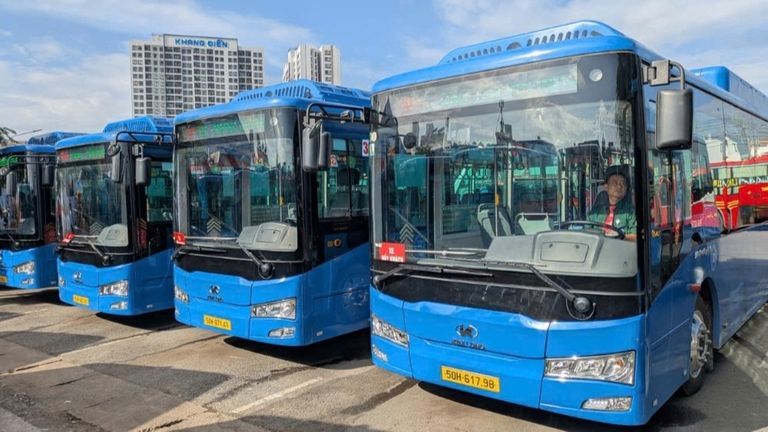
Ho Chi Minh City will make buses free for everyone. | Source: Lao Dong
On April 1, Ho Chi Minh City Party Secretary Tran Luu Quang announced that the city will offer free bus fares, which aims to lower commuting costs for residents, promote public transit, and gradually reduce environmental pollution.
Following this, the city will task the Department of Construction with developing a suitable plan to implement fare-free bus services. The program will cover 136 bus routes within the newly merged Ho Chi Minh City (including former Binh Duong and Ba Ria-Vung Tau), while inter-provincial lines will be excluded.
Encouraging the use of public transportation
Currently, the city already offers free bus fare for special groups such as seniors, children, and disabled passengers, while others pay subsidized rates of VND3,000–7,000. This new policy will expand free travel to the entire population for the first time.
According to the City Party Secretary Tran Luu Quang, the policy aims to encourage shifting from private vehicles to public transport, in order to curb traffic congestion and pollution – two of the burning issues Ho Chi Minh City has to address.
The City Party Secretary also states that the policy can also be a social welfare measure: It helps low-income residents cut costs while reducing the use of high-emission old motorbikes.
The announcement sparked strong public support, with many hailing it as a foundational step toward a modern metropolis. Residents described the move as the first step in Ho Chi Minh City’s journey to becoming a civilised, green city where public transit dominates.
While the fare-free policy may pressure the city budget, experts argue that the long-term benefits, such as reduced congestion, social cost savings, and a cleaner environment, far outweigh the costs.
Le Trung Tinh, Chairman of the Ho Chi Minh City’s Passenger Transportation Association, noted that the fare-free policy is consistent with current public transit development goals.
Mr. Tinh also reported that rising fuel prices led to a 35% increase in bus ridership. He suggested that, when funding is available, the policy would catalyse public transport growth.
Free, but also need to be accessible
Ho Chi Minh City currently operates 180 bus routes with over 2,400 vehicles, 1,300 of which are electric. With many routes running at under 50% capacity, officials see significant room for growth.
According to data from Ho Chi Minh City’s People's Committee, between 2020 and 2024, the city’s public transit only met 5-6% of total travel demand. Despite the population exceeding 10 million, the bus network remains sparse with low accessibility. Network coverage is also unevenly distributed, with high density in the city centre but significantly lower levels in suburban areas.
While the city has expanded its bus networks in recent years, a report from the World Bank in 2023 revealed that most bus routes still funnelled toward major hubs such as Ben Thanh or Cho Lon. This forces commuters to transfer two or more buses per journey, which significantly doubles or triples travel time compared to private motorbikes.
Moreover, Ho Chi Minh City’s bus system is dominated by large buses, which are inaccessible for narrow streets and alleys. The shortage of mini-buses and feeder services forces residents to walk excessive distances to reach the nearest stop.
Authorities have acknowledged this reality. The head of the City Party Committee emphasised that to encourage residents to opt for buses instead of motorbikes, the bus system must be attractive, convenient, and punctual. Beyond free fares, the city will need to improve service quality and expand its network. The Department of Construction has been tasked with restructuring the system toward greater efficiency and enhancing the overall passenger experience.
The Department of Construction will submit the policy to the City People’s Council for approval in April. If approved, the fare-free bus program could be implemented as early as May 2026.