Hui Bon Hoa's Villa Then & Now: From A Private Mansion To Public Memory
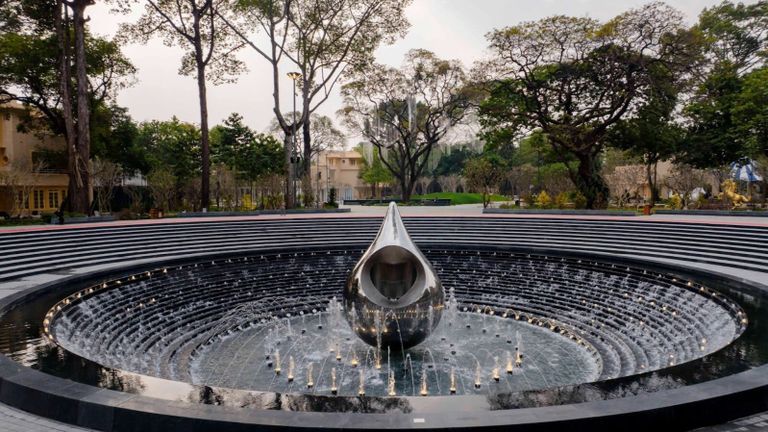
The Water Droplet Monument located in the park center, paying tribute to the Covid-19 pandemic's victims. | Source: Sun Group
In February 2026, Ho Chi Minh City officially introduced No.1 Ly Thai To Park, one of nine key urban projects marking a new development phase. HCMC’s planning priorities to expand green space and strengthen community-centered urban design.
The centrally located land plot, which has been left idle for years, has now been revived as an open public space. At the heart of the park stands the Water Droplet Monument, commemorating Covid-19 pandemic’s victims.
But before becoming a public green space, what did this estate represent?
Once home to old Saigon’s wealthiest family
Hui Bon Hoa was born in 1845 in Fujian, China, later arrived in Cholon-Saigon at the age of 20 and began working at a pawnshop owned by a Frenchman. Over time, he expanded into multiple pawn businesses and, more importantly, real estate business. By 1887, he had become a French citizen and steadily built one of the largest real estate empires in colonial Saigon.
Much of the family’s large-scale architectural development was carried out by his sons after his death in 1901. By 1975, the family had left Saigon. The properties were taken over by the government, some repurposed as cultural institutions. Yet not all of the family’s estates found immediate new life.
His family accumulated thousands of properties and owned many private houses in Saigon at that time, colloquially called Nhà Chú Hoả (Uncle Hoa’s Mansion). While the mansion at 97 Pho Duc Chinh (now the Ho Chi Minh City Fine Arts Museum) was built in 1929 by a French architect Rivera to honor Hui Bon Hoa’s legacy, the Ly Thai To villas (now No.1 Ly Thai To park) were constructed around the 1950s by his descendants as a resting place for Uncle Hoa's family after work.
From a private mansion to abandoned land
The Ly Thai To villas were originally eight separate houses. The symbolic eight meant prosperity in Chinese numerology. The compound served as a quiet residential retreat for the extended family along what was then Boulevard Hui Bon Hoa.
The villas were designed by French architect Paul Veysseyre, reflecting early 20th-century colonial residential architecture, blending European planning with local adaptation to tropical weather.
From 1954 onward, the villas became residences for members of the International Commission for Supervision and Control (ICSC), established under the Geneva Accords to monitor the ceasefire between French Union forces and the Viet Minh following the First Indochina War. After 1975, the Ministry of Foreign Affairs took over the compound and converted into a Government Guest House. One villa had already been damaged, leaving seven remaining structures. In 1996, the cluster was included in a municipal list of 108 architectural landscapes recommended for preservation study.
Yet preservation paid little attention. By 2017, the site had effectively been left idle. Overgrown trees enveloped the villas; roofs leaked, walls cracked, and interiors decayed. Despite occupying prime “golden land” in District 10, the compound stood in limbo, neither redeveloped nor restored.
In November 2025, three of the seven villas were dismantled. The reason given was severe structural deterioration.
The three demolished villas numbered 2, 3, and 4 were said to have shown major cracks in load-bearing structures, water infiltration, mold, and concrete erosion, posing safety risks. Authorities stated that four remaining villas, whose structural integrity was deemed stable, would be retained.
Critics questioned both the timing and the process of the demolishment. Urban researcher Tran Huu Phuc Tien, a member of the Ho Chi Minh City Urban Planning Association, described to BBC News Vietnamese that the seven villas are architecturally refined structures worthy of adaptive reuse. In his view, preserving them would not be a burden, but an opportunity: to create thematic cultural spaces, educational centers, or creative hubs within the future park.
The “golden land” debate: Preservation or replacement
In a city where real estate values continuously rise, some argued that the site should be redeveloped into a modern commercial complex for higher economic returns. Their reasoning is straightforward: the property belonged to an individual who lived more than a century ago and no longer has a direct presence in the city’s contemporary social fabric. As urban life evolves, land, they contend, should be repurposed to meet present-day economic and functional demands.
Yet another view emphasizes public memory. Even if the original owner no longer shapes today’s Saigon, the layers of history embedded in the site contribute to the city’s identity. Erasing them entirely would mean flattening those narratives.
The expansion of public spaces
No.1 Ly Thai To Park was once a private enclave and abandoned land, now has been reopened into a shared civic space. Ho Chi Minh City chose restoration and transformation, over commercial redevelopment.
The authorities are taking a clear step toward sustainable urban development by investing in green spaces that enhance residents’ quality of life. In a dense metropolis where public space is limited, converting former private estates into accessible parks reflects a broader shift in priorities.
The transformation is also symbolic. At the park’s center stands the Water Droplet Monument, designed to resemble falling tears within a memorial space. In this way, the site links layers of the city’s history, from its colonial past to the collective memory of the Covid-19 pandemic, bringing different moments of the city’s story into a single landscape.